
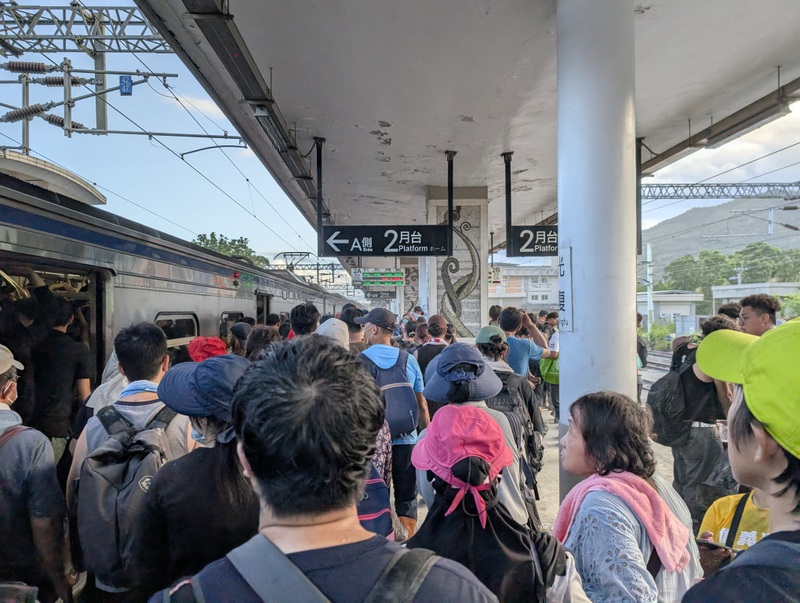
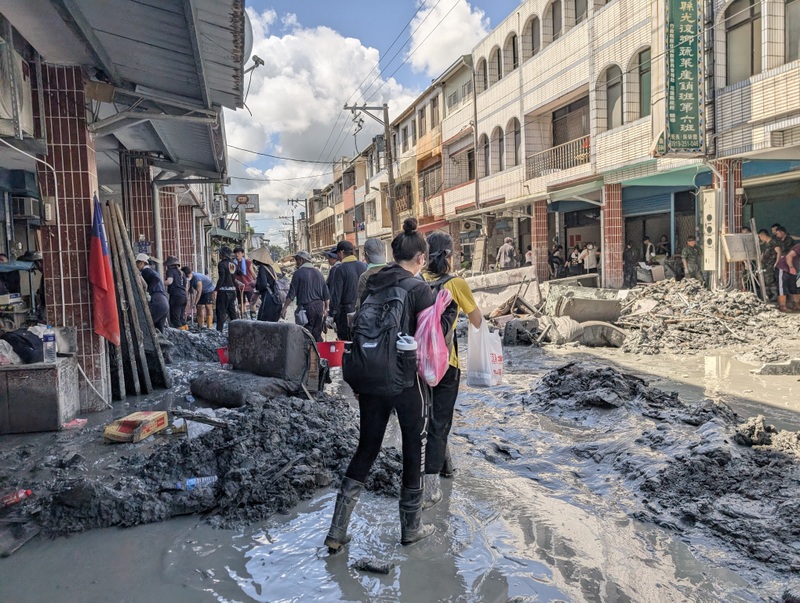
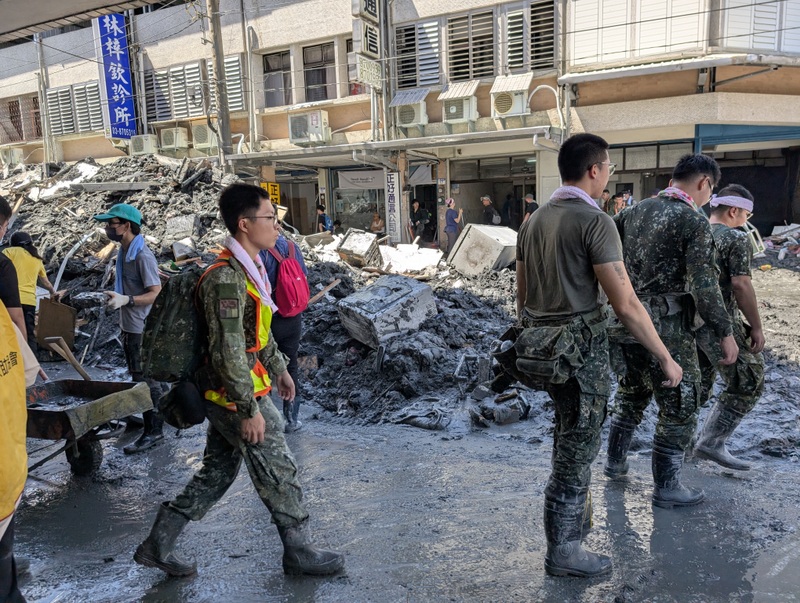
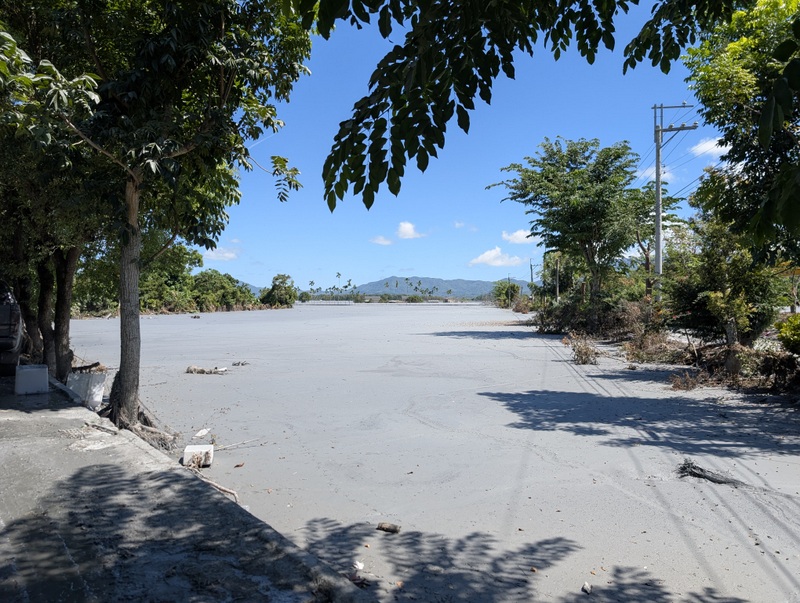
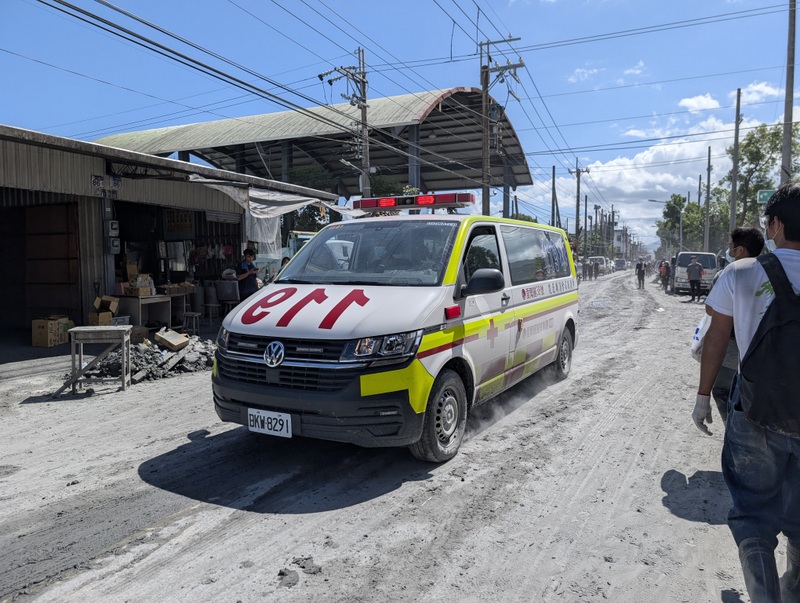
The train from Hualien, packed to the limits, pulls into Guangfu Station. It’s Sunday, September 28, and Taiwan has a 3-day holiday weekend for Teacher’s Day, Confucius’ Birthday. It’s the smell that gets us first. Then the dust. It’s everywhere, in our eyes, nose, and mouth, covering our phone screens. Facemasks are essential. But the heat, oh the heat, and facemasks just make it hotter and even more unbearable. Then there’s the mud, sludge, and water covering everything. Trudging and squelching our way down through the town in the mud, we join thousands from all over Taiwan who have descended on the small town of Guangfu to volunteer. Men and women, old and young, skilled and unskilled, friends and total strangers, we have all answered the call to come and help. We weave among bulldozers and lorries that are hard at work trying their best to clear all the mud and piled-up debris outside people’s homes. It’s all surprisingly well-organized; the army, police, and traffic wardens all on duty, directing us around and along back roads to our destinations.
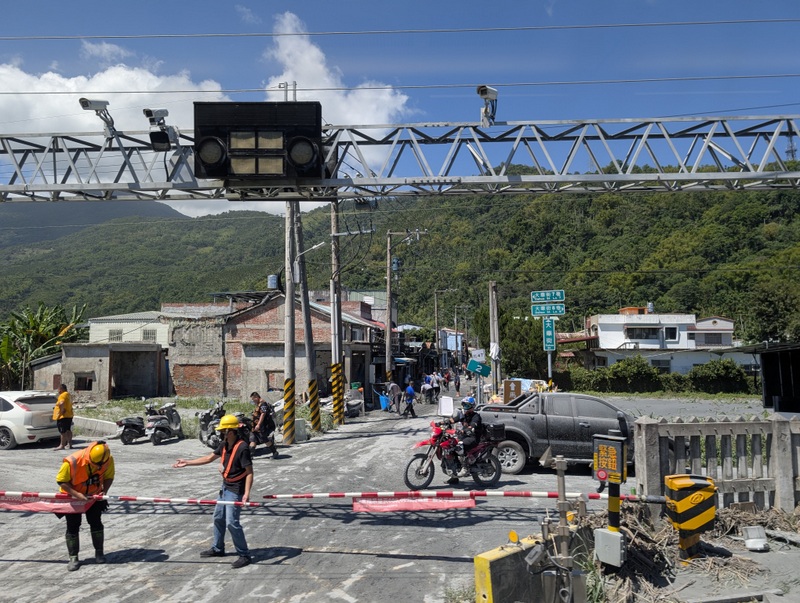


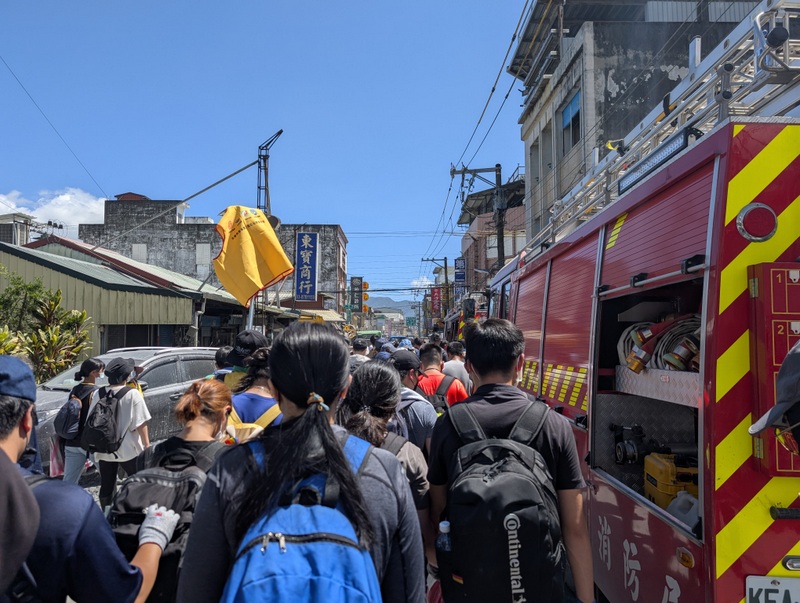


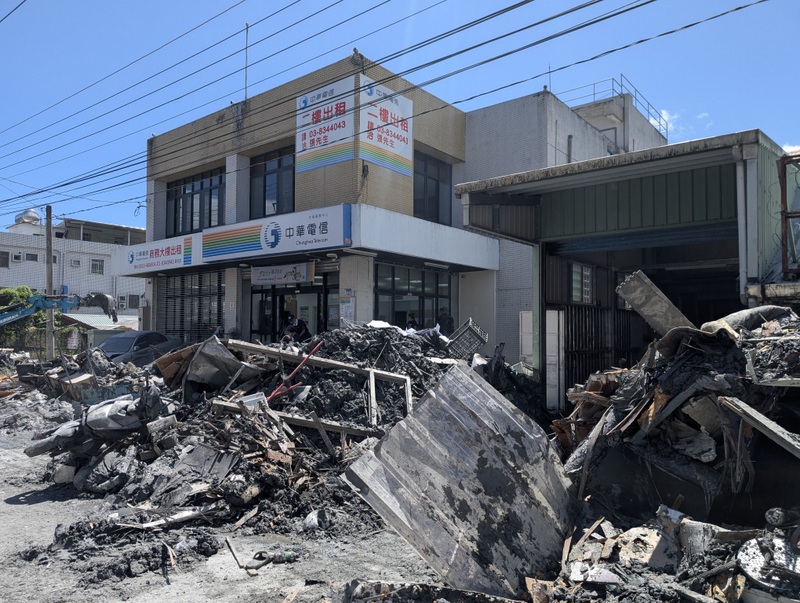


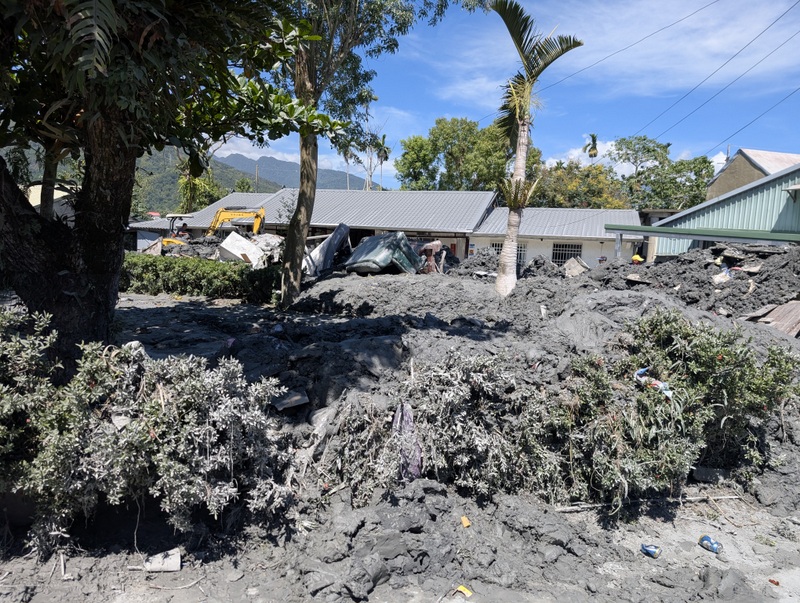
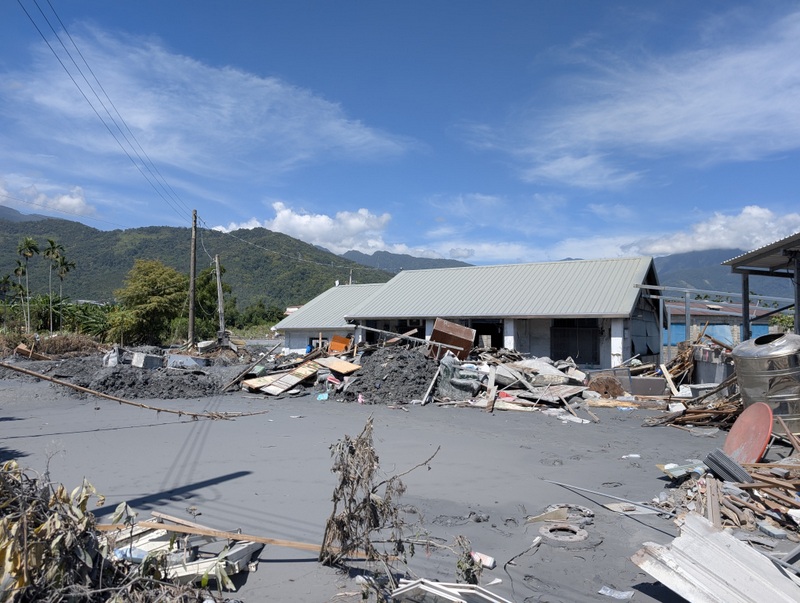
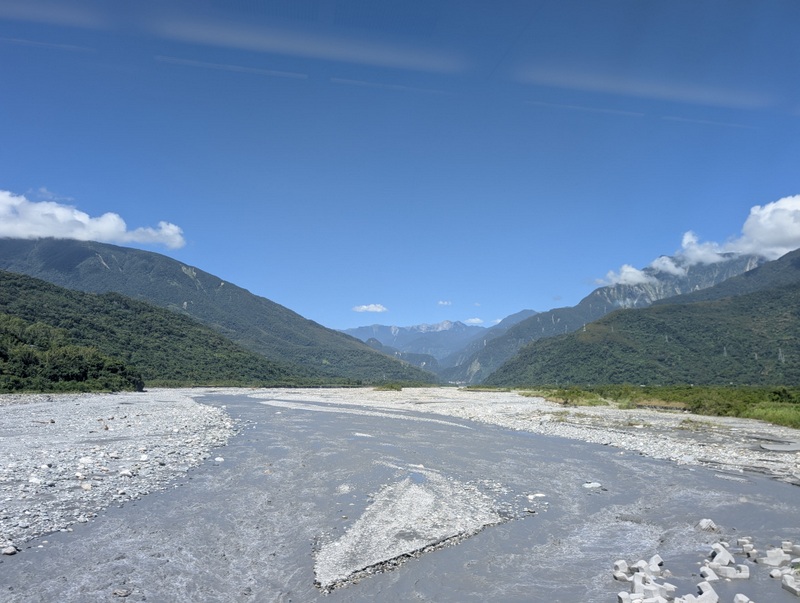
Why are we here? The Guardian has an excellent summary: “This small town in Hualien, a picturesque county on Taiwan’s east coast had long been a magnet for tourists, before disaster had struck a week ago. The outer bands of 2025’s strongest typhoon, Ragasa, dumped torrential rain on the region, and last Tuesday afternoon it burst a precarious barrier lake in the Matai’an river. The lake, formed by a landslide in July, had been under constant monitoring and authorities had expected it would overflow, but it exceeded expectations. More than 15.4m tonnes of water came down, blasting a tsunami of thick sludge into Guangfu. At least 18 people died. Dirt and debris is piled high in the streets, as people empty out ground floor dwellings. Destroyed cars are piled in corners, and the high school sportsfield lies underneath a metre of mud. The destruction gets worse closer to the river, where some houses on rural land are buried up to their roof. Most of the deaths occurred here.”

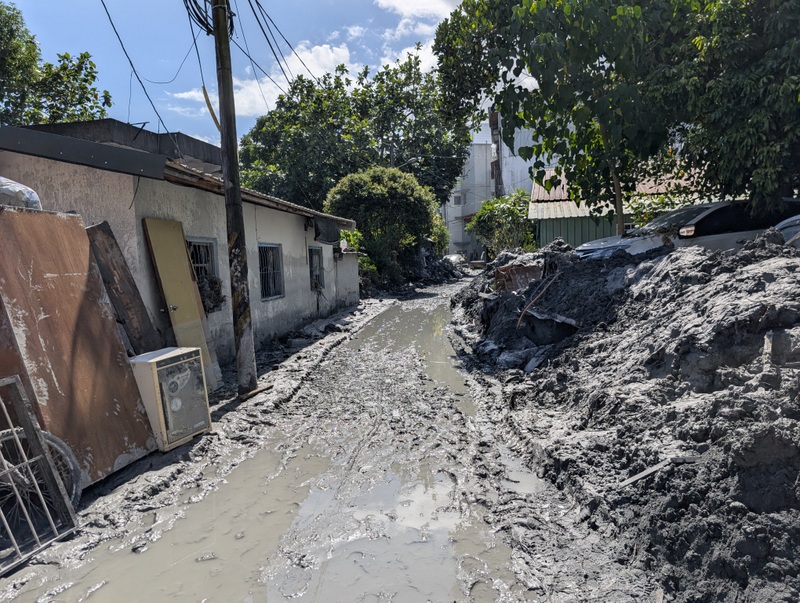
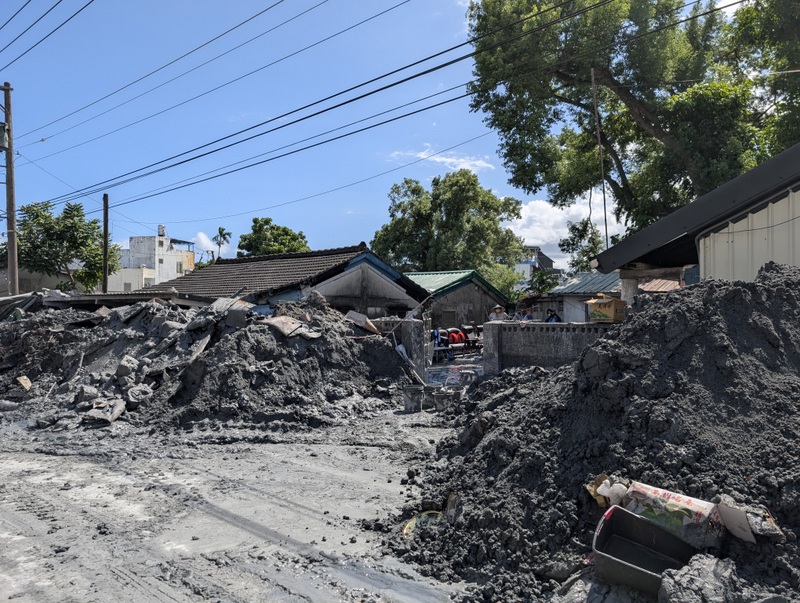
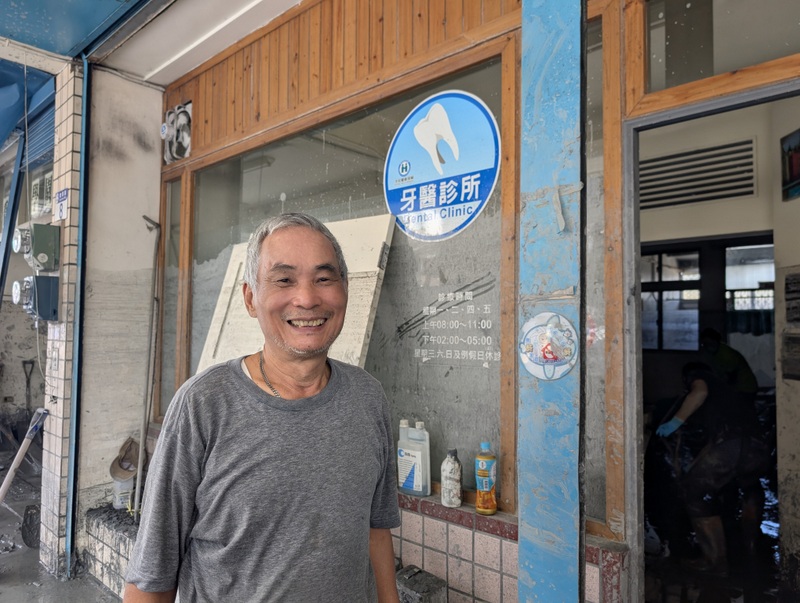
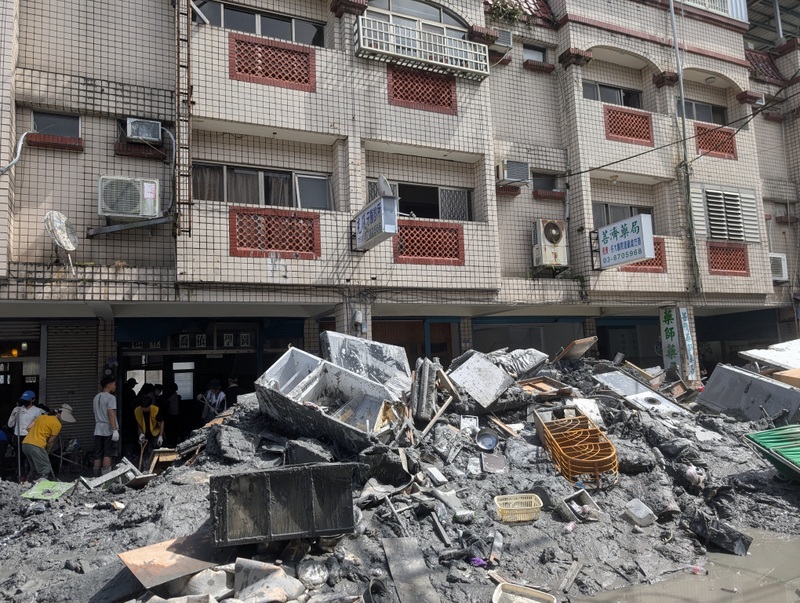
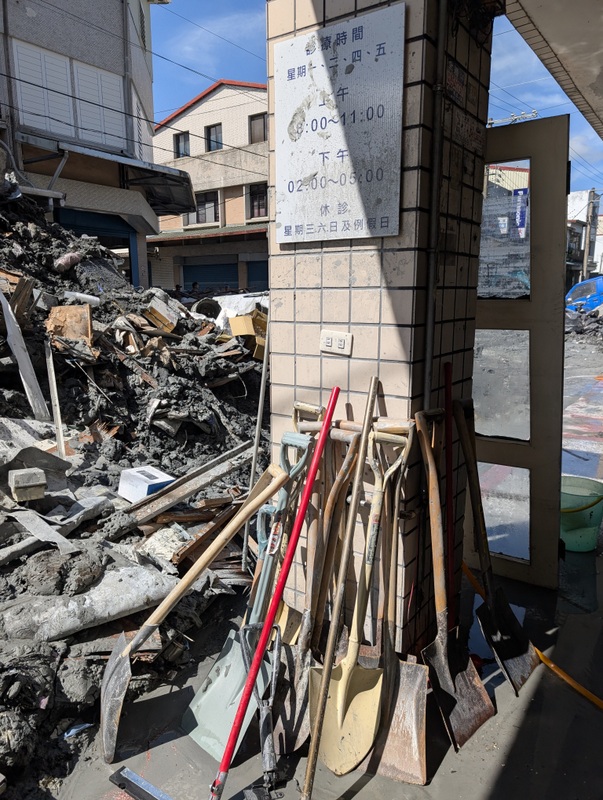
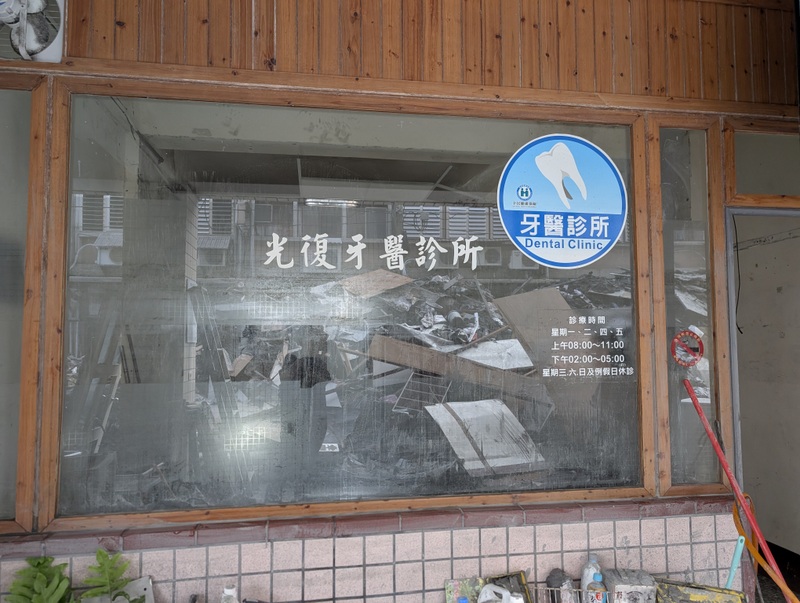
After about 20 minutes of slithering, sliding, and squelching our way along and around the roads of the town, we arrive at our destination, Guangfu Dental Clinic 光復牙醫診所 at No. 8, Dunhou Road. This is Dr. Kuo’s clinic. The clinic is about halfway between the station at the top of the town, and the river; the further down nearer the river you go, the deeper the mud and the higher the floods. This was the scene greeting us outside Guangfu Dental Clinic, with piles of debris filling Dunhou Road. The clinic is on the right, marked by a white sign with blue writing.


Dr. Kuo 郭導天 and his wife, Ms. Hsu 徐克洋, are members of St. Luke’s Episcopal Church, Hualien, and for the last 42 years, they have been faithfully running Guangfu Dental Clinic. St. Luke’s Church, Hualien is the only Anglican / Episcopal Church on Taiwan’s east coast, and every Sunday for the last 42 years, Dr. Kuo and his wife have traveled the 50 km (30 miles) from Guangfu north to Hualien to join the morning service at St. Luke’s Church; and they regularly join in other church activities, like Bible Studies and helping to serve at the summer camp. This photo below was taken in August 2025, when Rev. Joseph Wu was installed as the vicar of St. Luke’s Church (for the second time, hence he’s already very familiar with everyone); you can see Dr. Kuo and his wife smiling and standing on the far left (second and third left) on the front row.

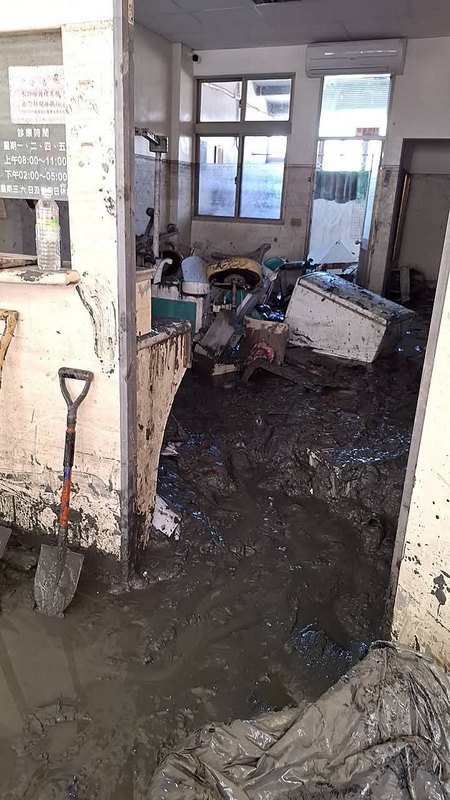
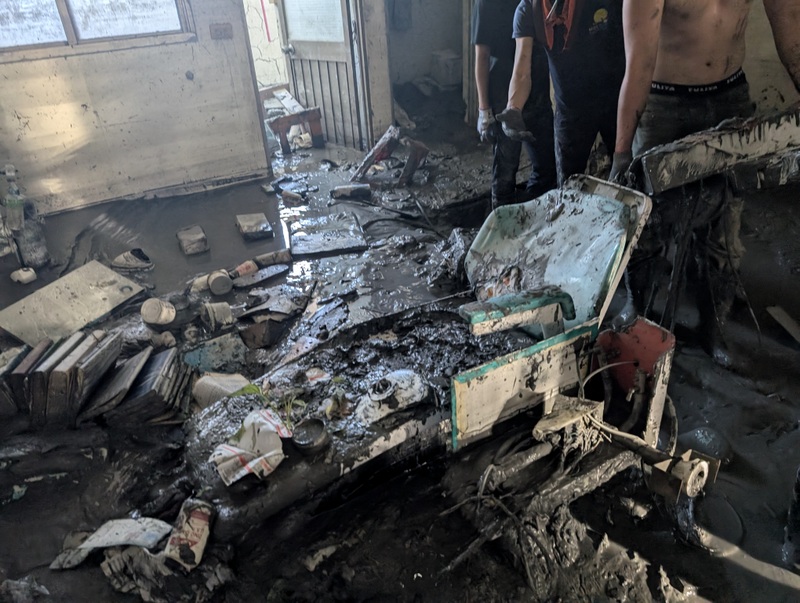
Dr. Kuo is originally from Hong Kong, and many years ago, he came to Taiwan to study dentistry at what is now known as Kaohsiung Medical University. After graduation, he got a job in the Mennonite Hospital in Hualien, which is where he met his wife, who is from Hualien. Dr. Kuo had grown up in St. Stephen’s Anglican Church, Hong Kong, and so when he moved to Hualien, he joined St. Luke’s Episcopal Church. He and his wife were married there on December 3, 1982 and one month later, on January 2, 1983, they opened their dental clinic in Guangfu, the first – and for many years the only – dental clinic in the town. They’ve served there faithfully ever since, and have brought up their son in Guangfu; he now lives overseas. Even though Dr. Kuo and his wife are now in their seventies, they hadn’t retired, and the clinic was still going strong right up until the day the floods came, which was Tuesday, September 23. These are some of the first photos taken immediately after the floods.

Everyone I’ve met tells me that Dr. Kuo and his wife are kind, humble, compassionate people, much loved by everyone, and always with a smile; they are known in the town for waiving registration fees for the elderly and those in financial hardship, and on occasion have opened up their clinic in the middle of the night to treat patients with severe toothache. A sympathetic, kind, and compassionate dentist is worth traveling for, and so, not surprisingly, church members from St. Luke’s Church would travel to Guangfu for their own dental treatment.
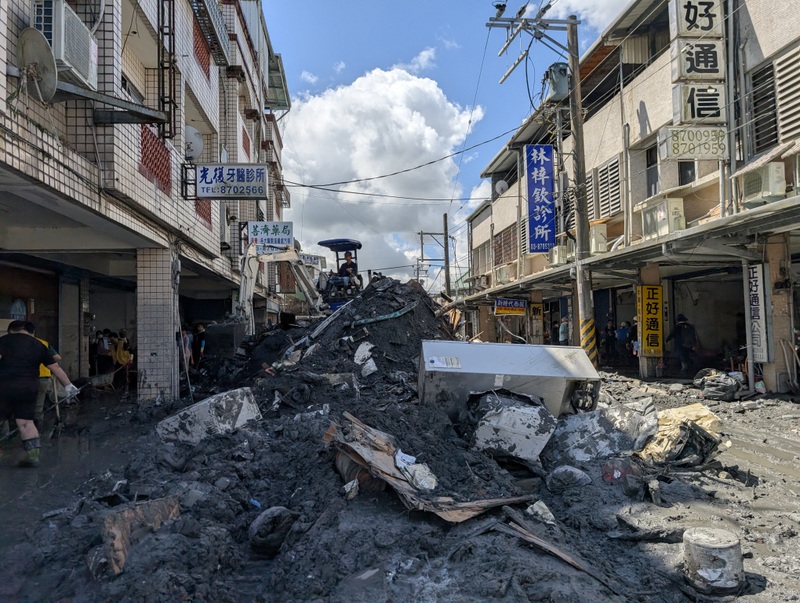
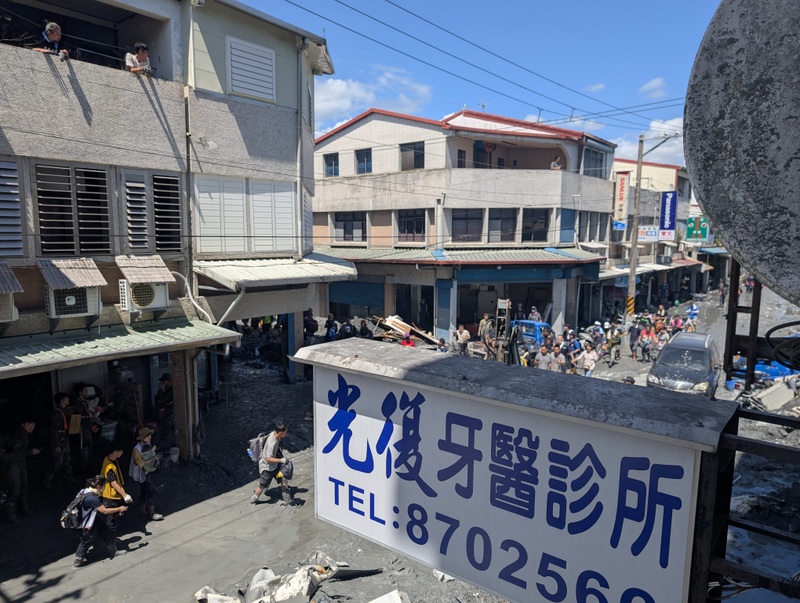
Dr. Kuo’s dental clinic is on the ground floor, and the couple live on the 2 floors above. Fortunately, when the floods came, they managed to take refuge on the upper floors of their home. That’s also where we found ourselves soon after arrival last Sunday, when the warning went off that more water was coming. There is still a danger of more mudslides, although on that occasion, nothing happened and we were fine. As we looked out across the street, we could see everyone gathered on the top floors of the homes opposite. About 30 minutes later, the all-clear was given and we could resume work.

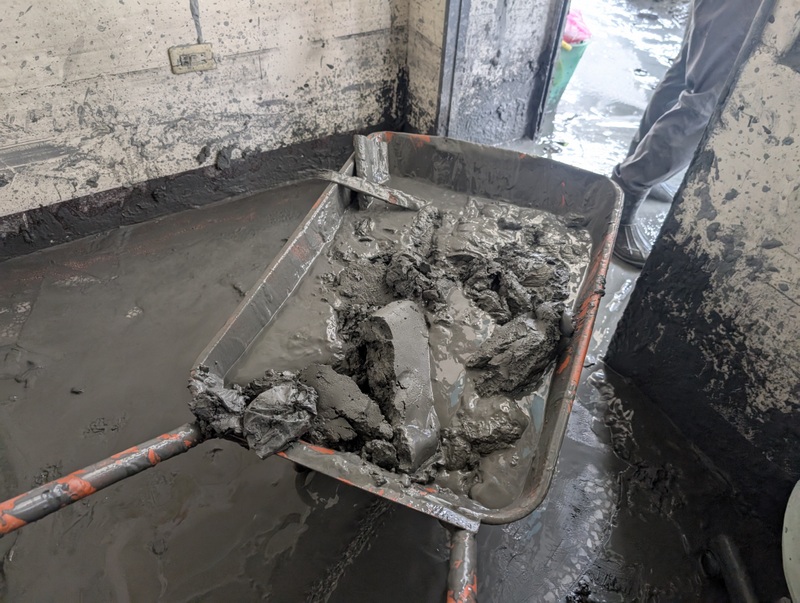
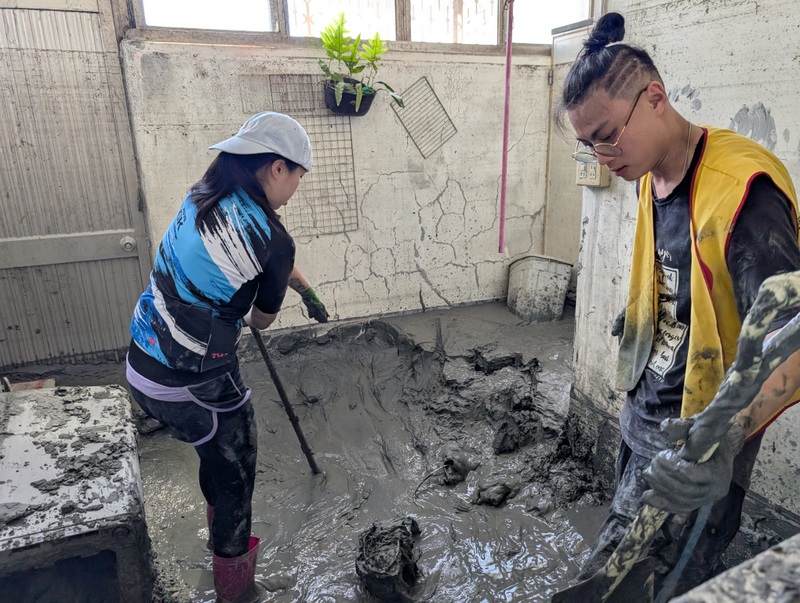
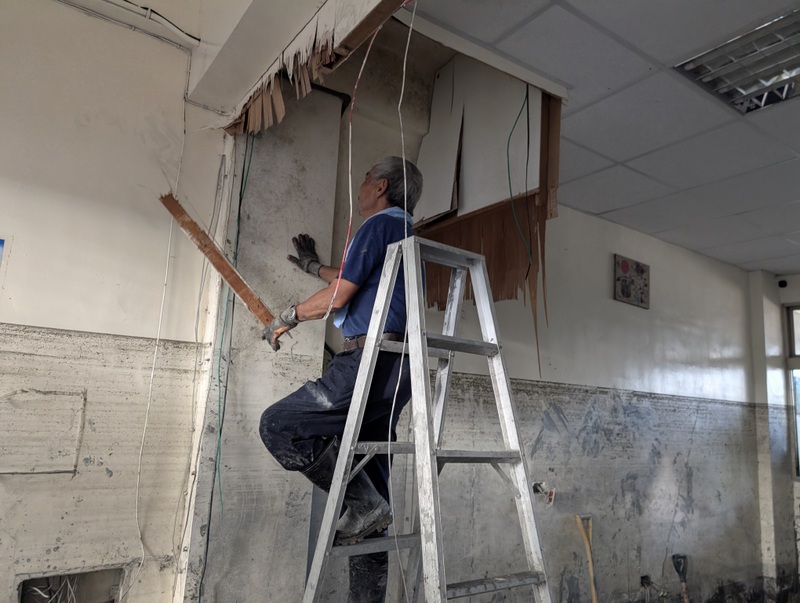
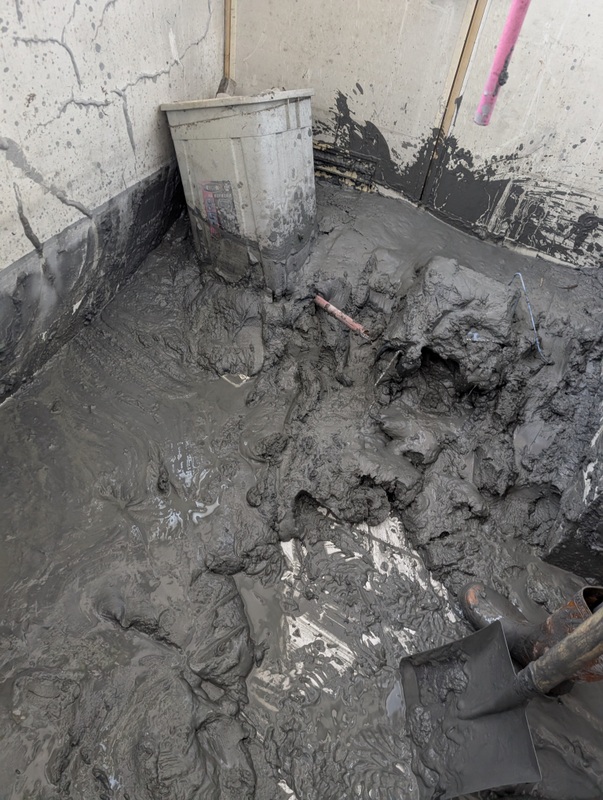
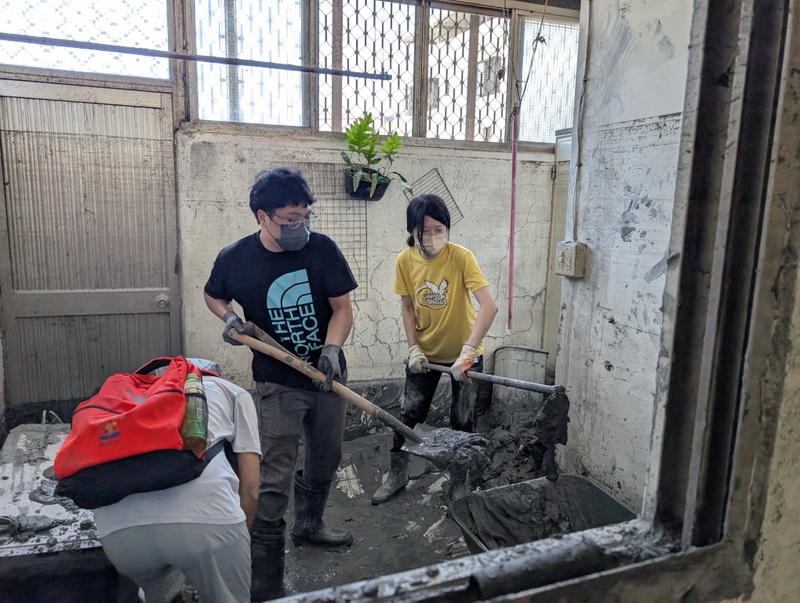
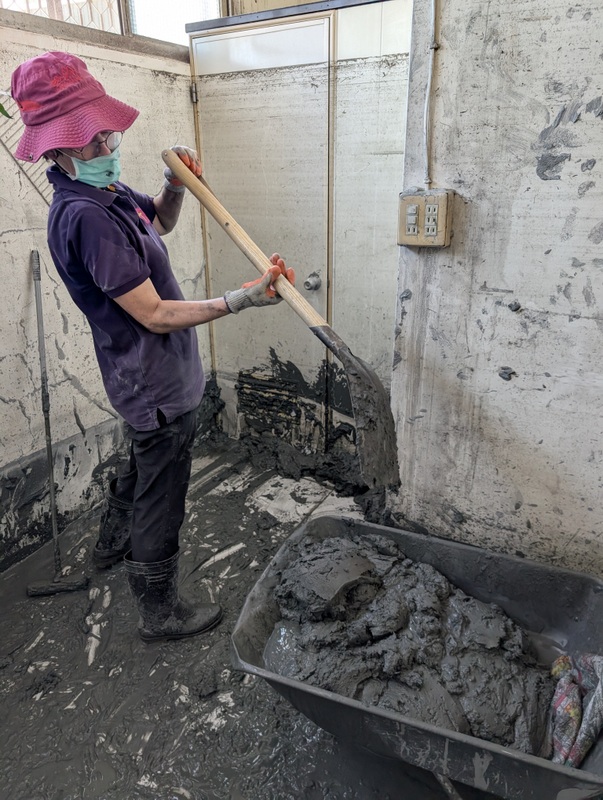
When we arrived on Sunday, to help, much of the water had drained away, leaving a layer of thick sludge all over everything in the clinic, including all the equipment, the x-ray machine, the dental chair, the computer, the washing machine, plus all the files and records. Everything had to go. We also had to take out all the interior wooden walls and doors, leaving a totally bare, empty room. That first day was the hardest; it was all digging out mud, smelly, horrible mud. We were all disgustingly dirty and hot (it was 30°C all day), but we managed to clear most of the mud from the main room and the X-ray room. Relief and exhaustion all round.


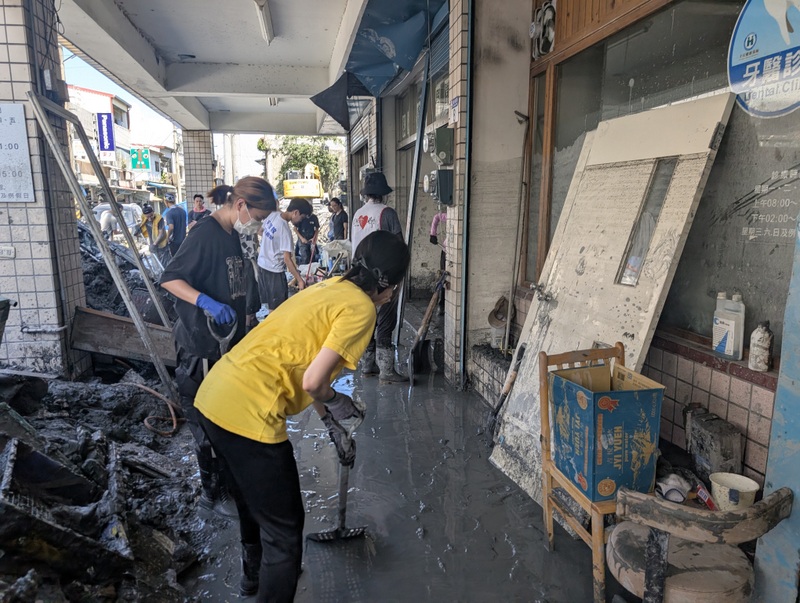
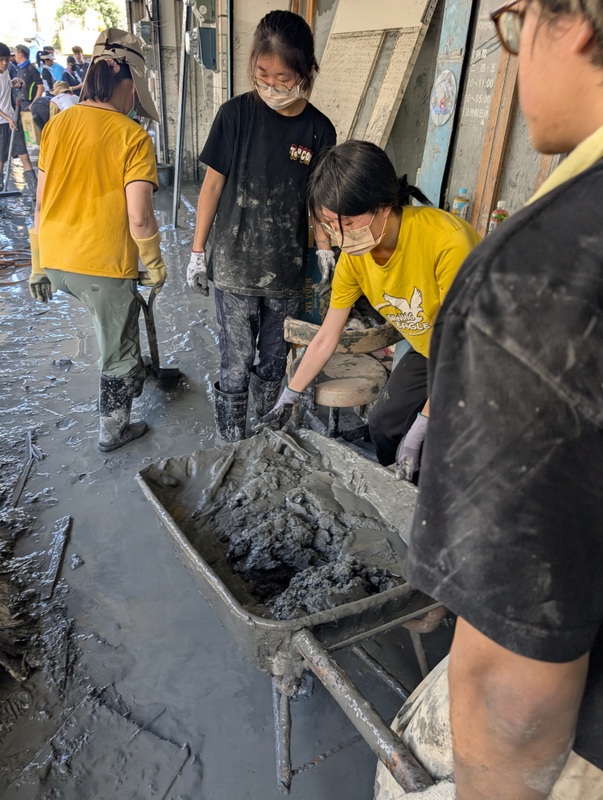
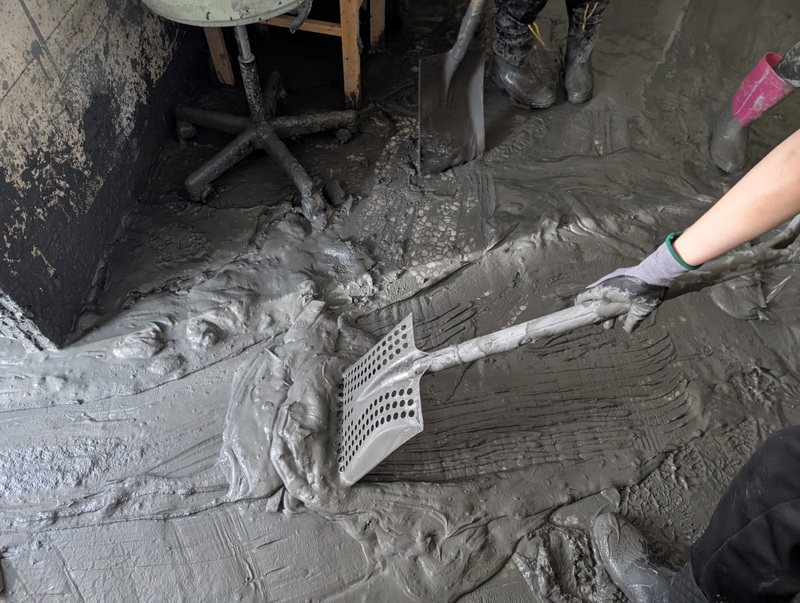

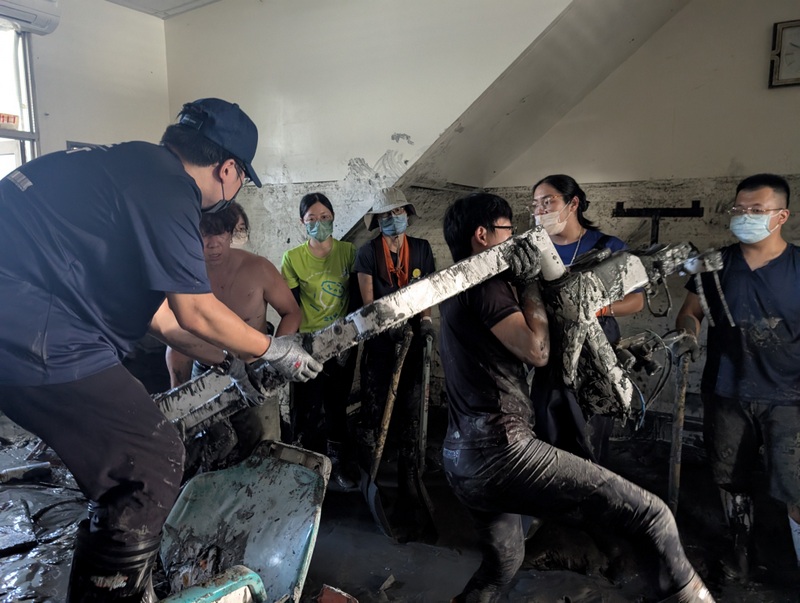
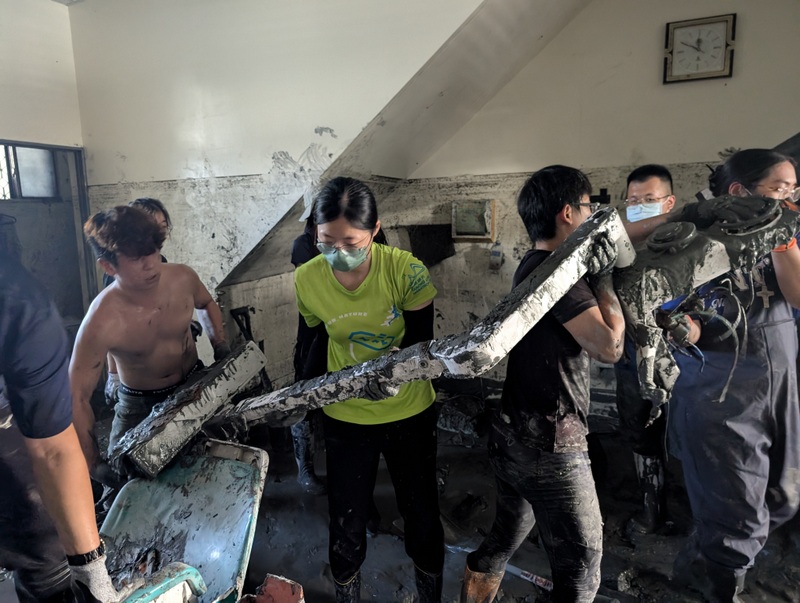
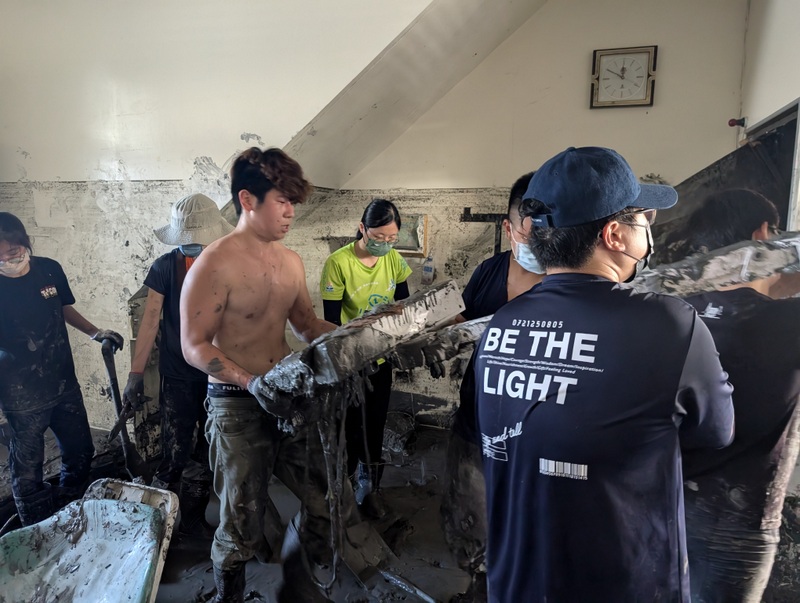



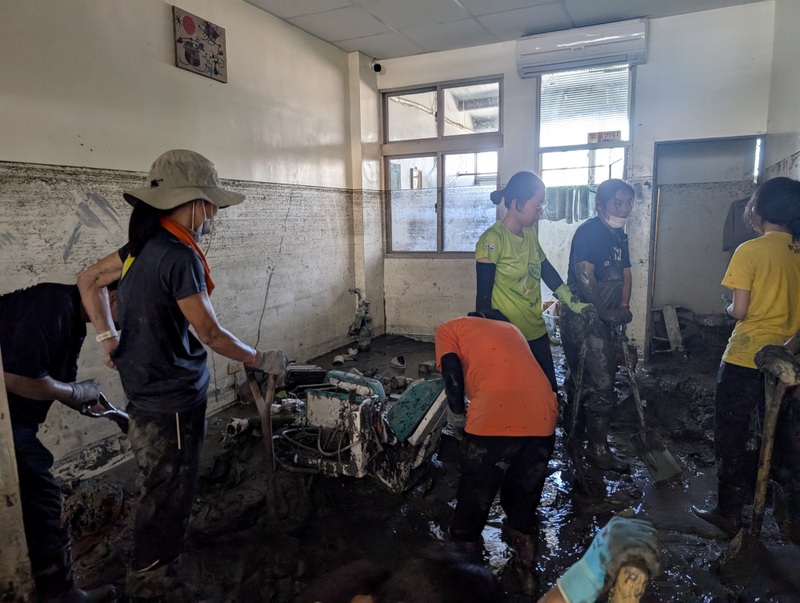

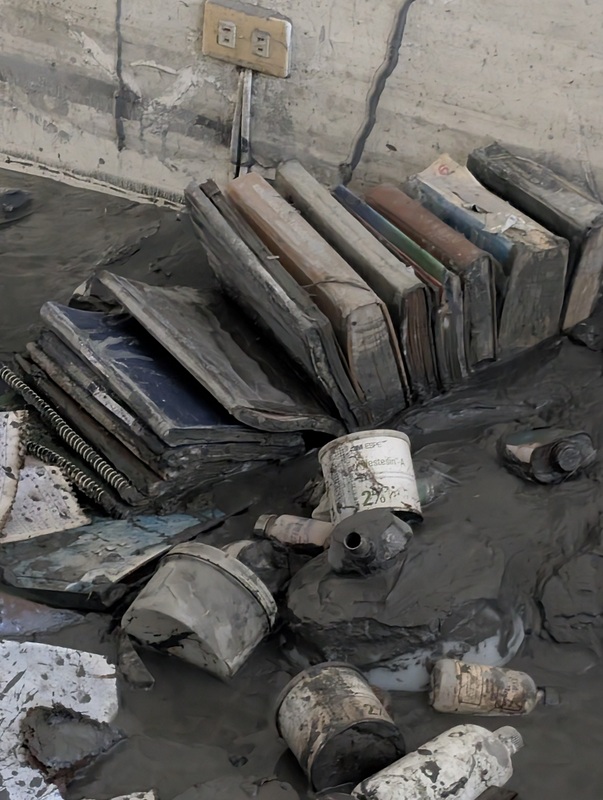


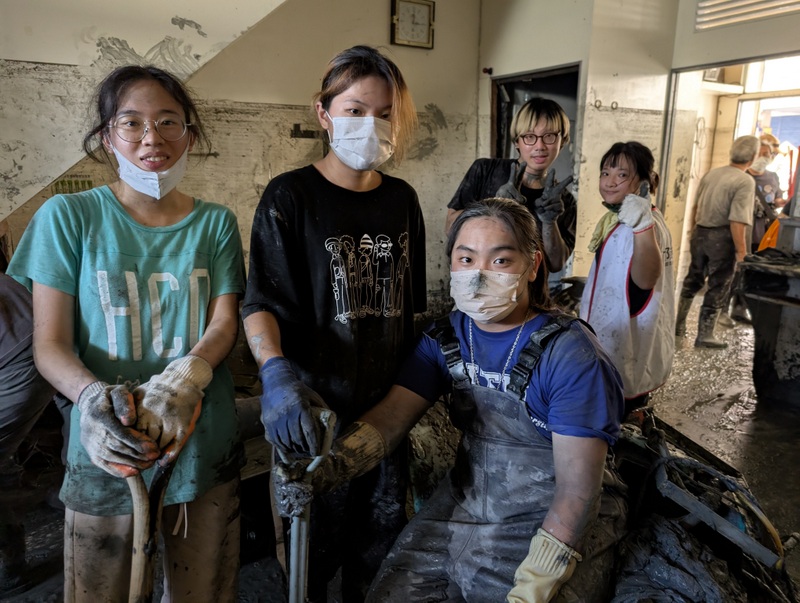
Dr. Kuo and his wife were not in Guangfu the weekend we were there; they had gone on a pre-arranged trip to Macau to attend a funeral of a close friend, so the family member in charge was Ms. Hsu’s younger brother, Mr. Hsu, along with his daughter and son-in-law. In a quiet moment, I persuaded Mr. Hsu to take a photo. We also took a photo with his daughter; she’s the one in the middle. They were amazing, and totally dedicated to the task at hand, as well as being very practical and knowing exactly what to do.
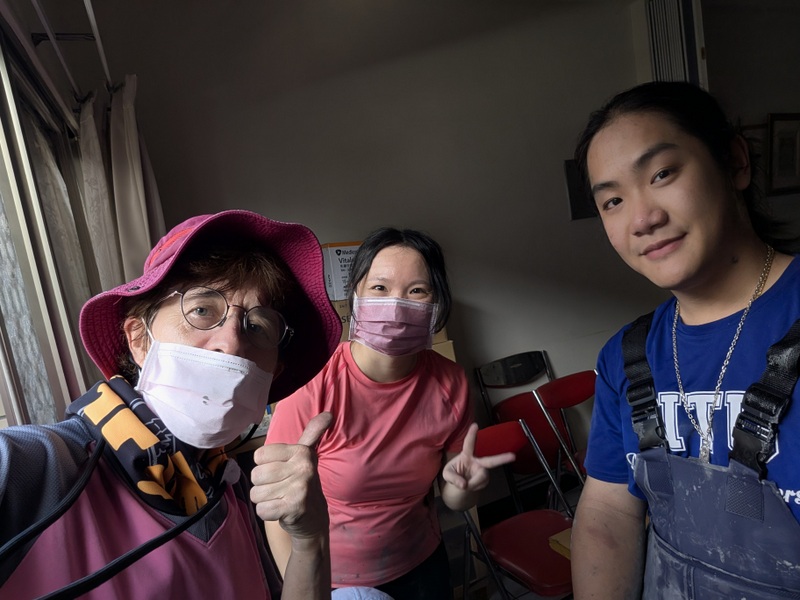
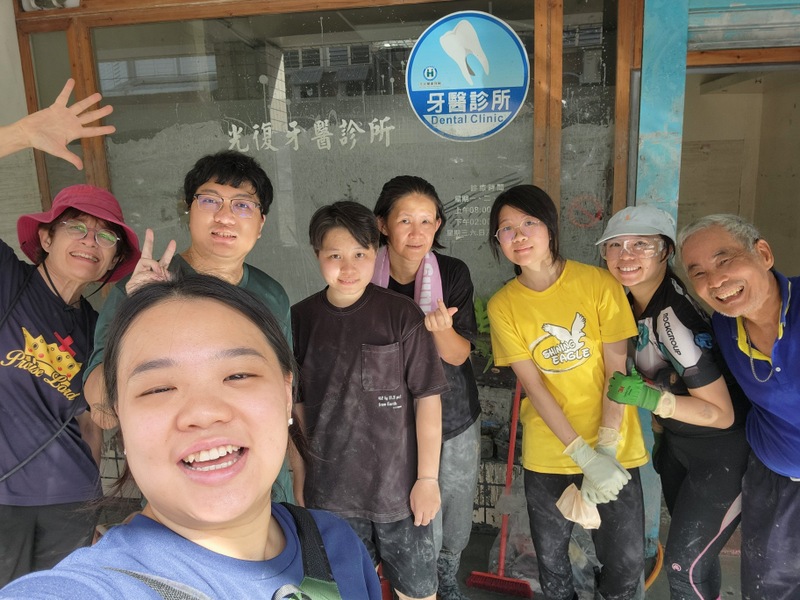
There is a dark line on the wall of Dr. Kuo’s ground-floor clinic, showing where the mud and water came up to. We had our group photo taken there at the end of the first day. You can see the line below, it is well above our heads. It’s clear, none of us would have survived that water and mud unless we could get to a higher floor.


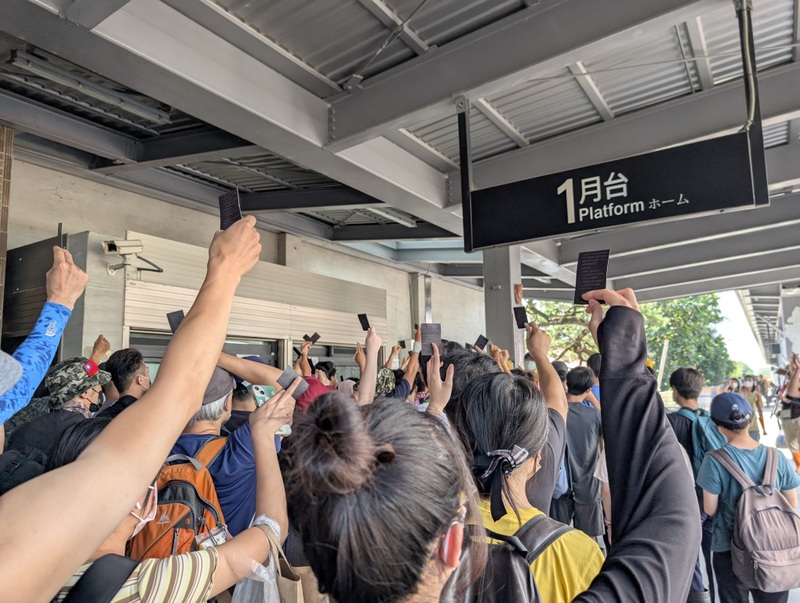
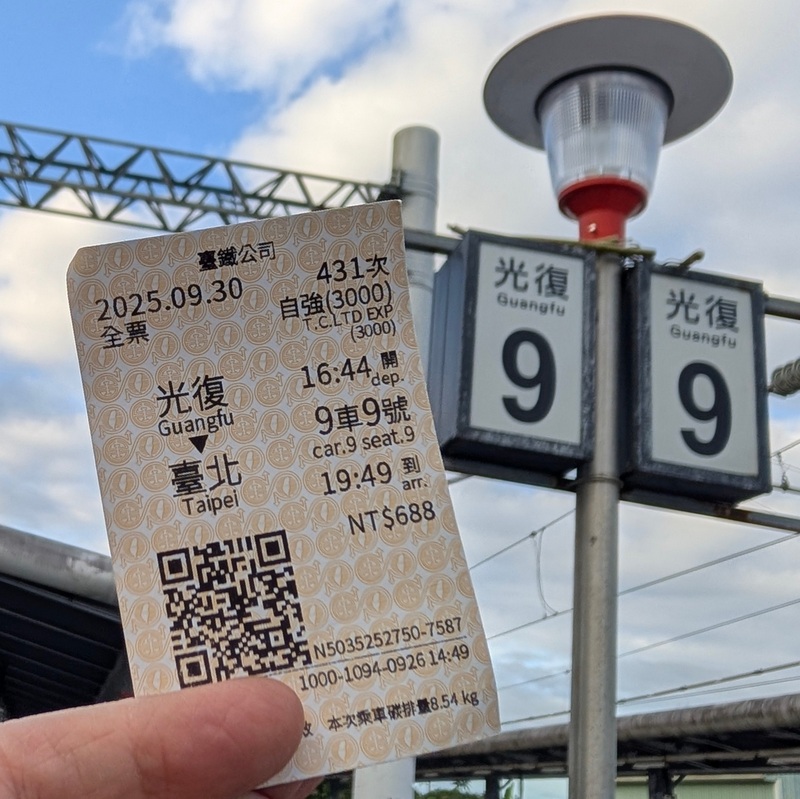
Leaving the clinic to go back to Guangfu Station took us past people at the side of the road offering to hose down our boots, others were handing out bread, drinks, and even T-shirts. The huge crowds at the station were calm, good-natured, and patient; there were so many people that by the second day, the station staff asked us just to hold up our tickets so he could see them as proof that we had one.



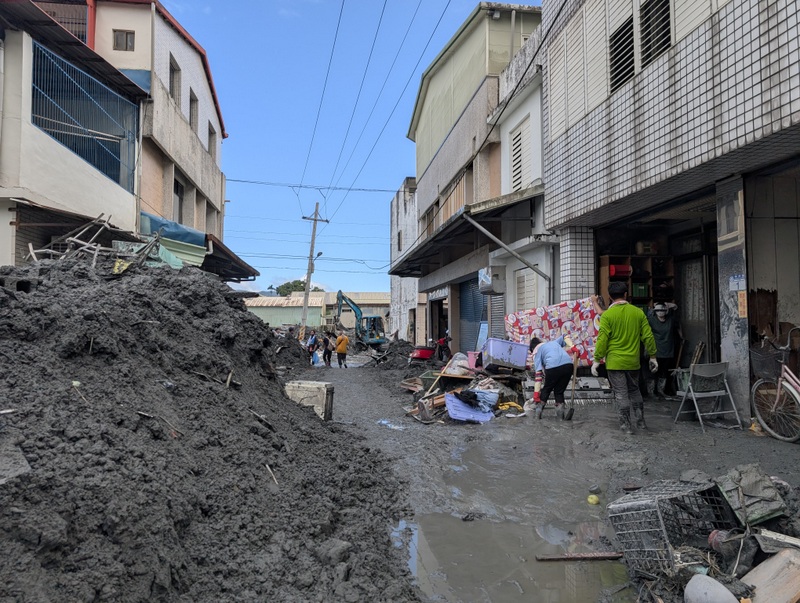


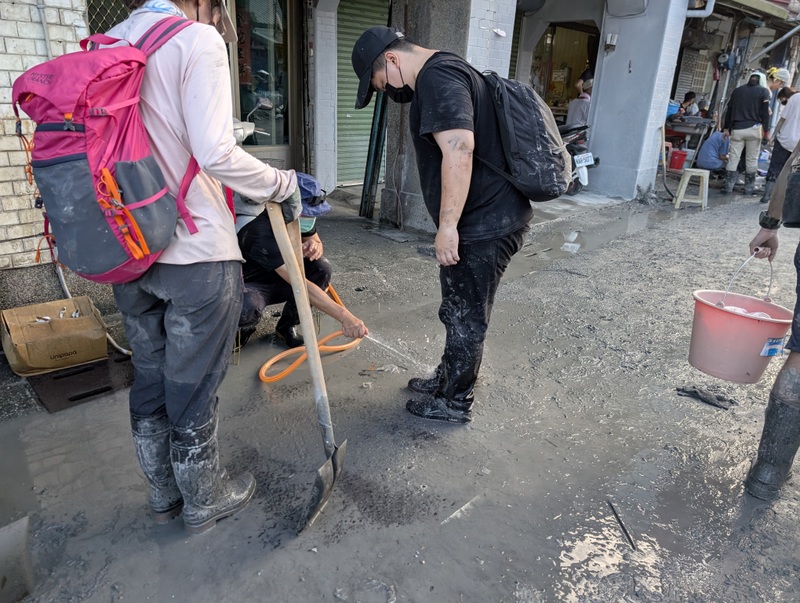



On Monday morning, our second day, we had another long walk, slogging around the muddy side streets to get to the clinic; as the main road was being kept free for traffic going down to the worst-affected area, nearer the river. This time, we knew what to expect when we arrived.





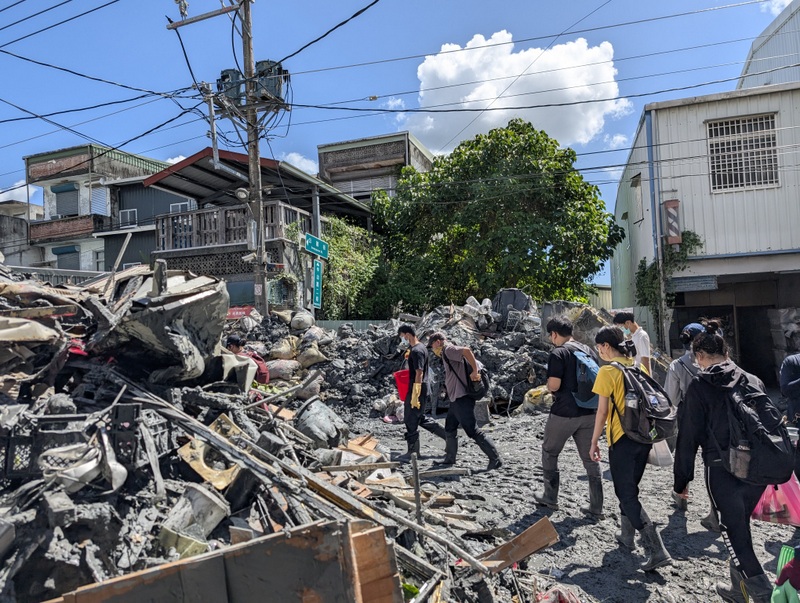
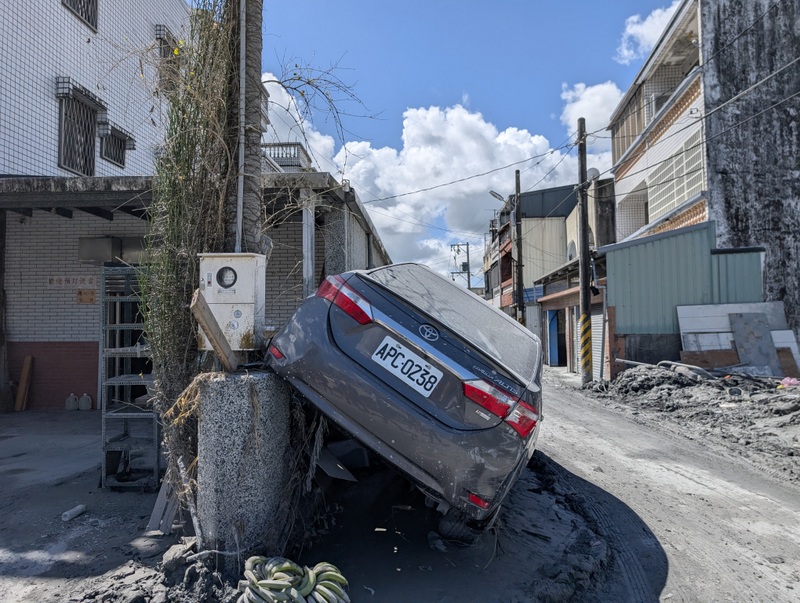
That day was spent digging out the mud from the back room and toilet. It was all disgusting. When we had finished, we still could not open the back door. Outside the back door was a field of mud, with cars immersed up to their roofs. Somewhere out there, though parked closer to the road, had been Dr. Kuo’s car too. Like most of his neighbours, his car is gone.






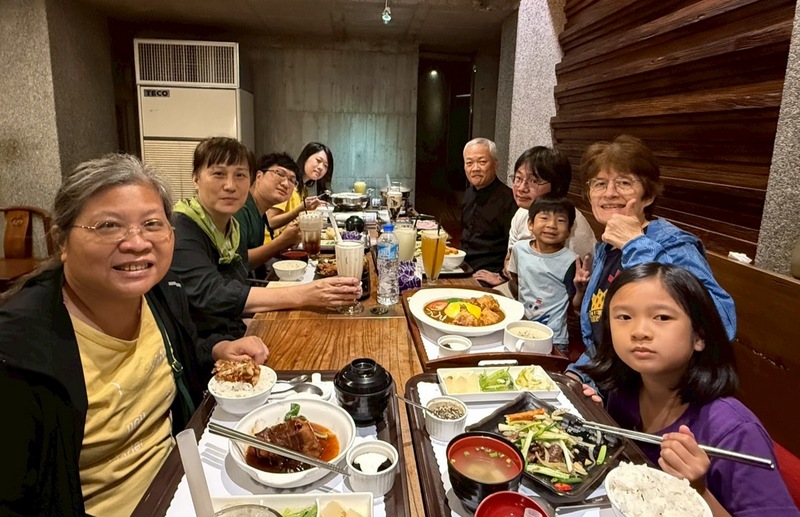
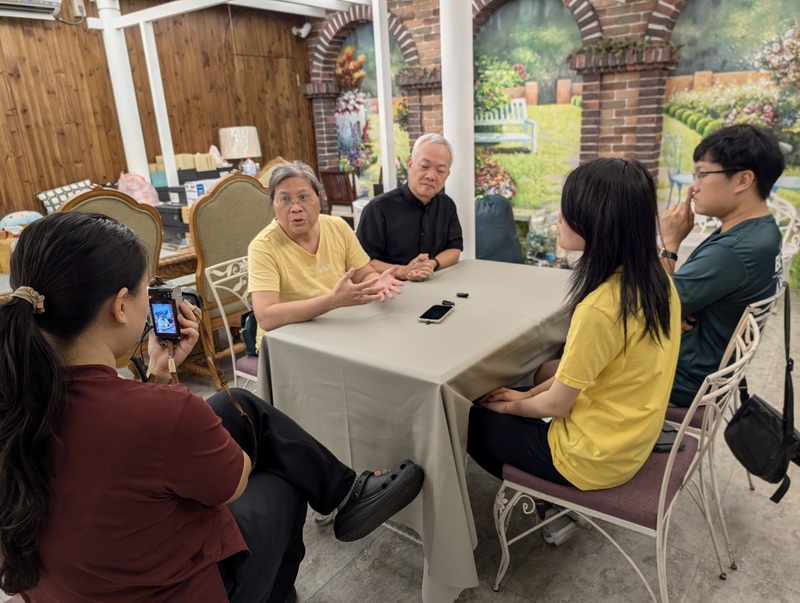
That evening, Rev. Joseph Wu and St. Luke’s Church kindly invited us out to dinner. Here we all are! Vicky from the diocesan communications team joined us later to interview the Wu family for some posts she is doing – they’ll probably appear on the Taiwan Episcopal Church Facebook Page.
On the Tuesday, the third day of our visit, Mr. Hsu brought along a high-pressure hose to clean down the walls. Even getting that equipment into Guangfu was quite an adventure because the main road bridge has been washed away, and traffic on the other smaller roads is strictly controlled to only allow essential vehicles in and out, so Mr. Hsu had to push his equipment a long way through town in a wheelbarrow. We also cleaned up the floor above, where Dr. Kuo and his wife have their living room. Though not deluged in mud, like the floors below, the white floor had become completely dirty due to us all traipsing up and down the stairs in our muddy boots. Everywhere was also full of dust. When we left Guangfu on Tuesday evening, after 3 days of hard, strenuous, back-breaking work, the ground-floor clinic was completely empty, apart from the remains of the dental chair, which was bolted to the floor.
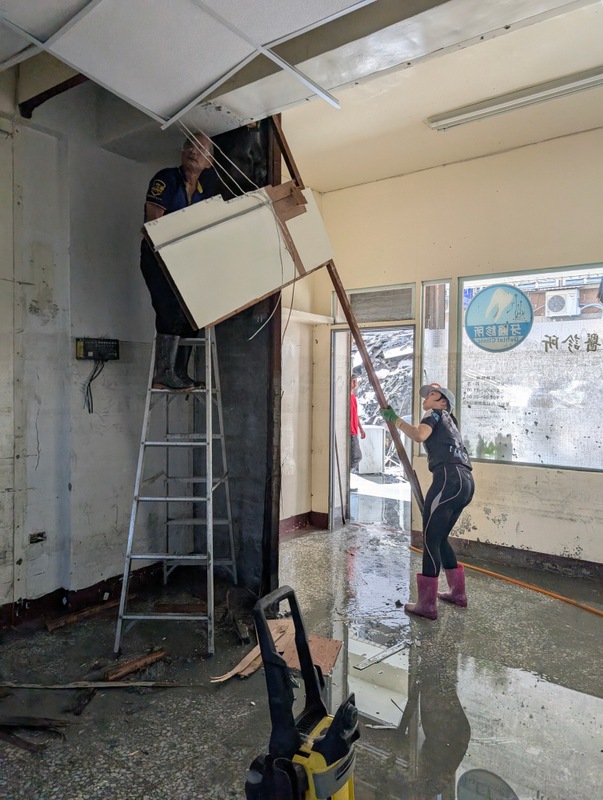
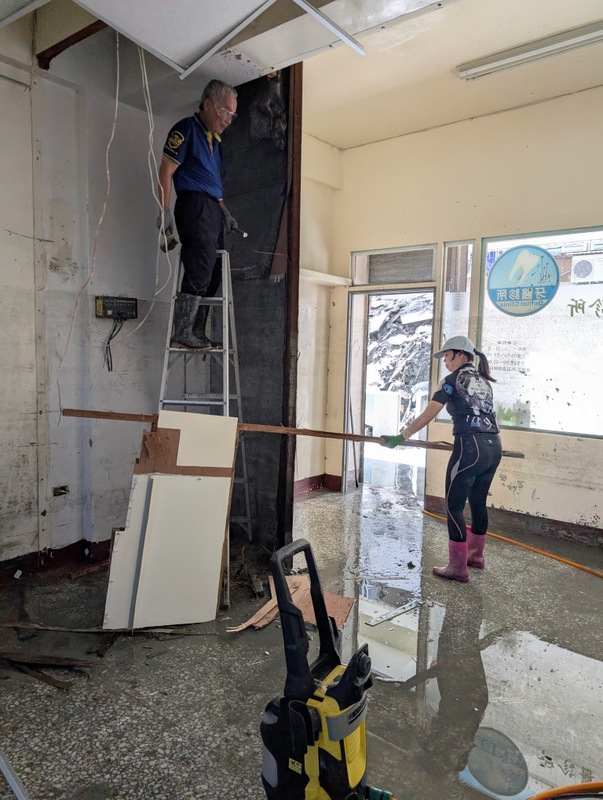


And our final group photos on Day 3:

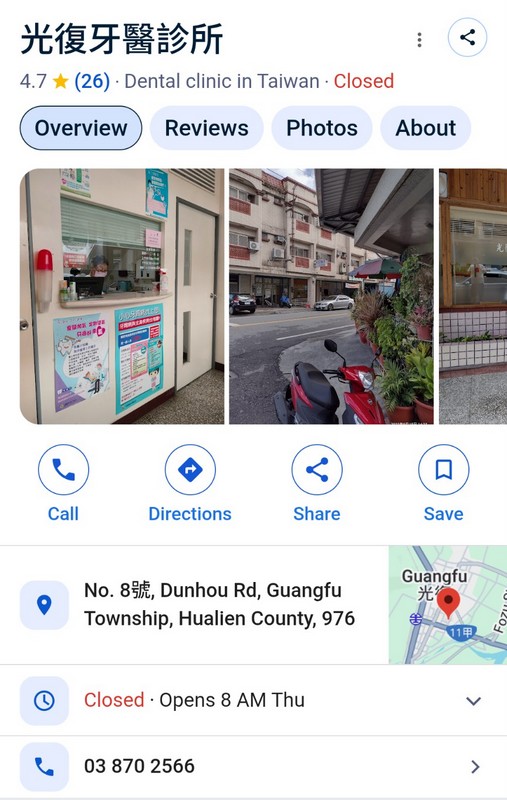
You can see from the photos on Google Maps at the link here what Dr. Kuo’s clinic looked like before. So beautiful, so bright, so clean. Now it’s just a big empty room. Their life’s work in that dental clinic all gone.


Their neighbours too have had a similar experience. We got to meet some of them, there’s a pharmacy and a hair salon on one side, a cram school on the other, and across the road, a doctor’s surgery. All of them have been there for years, and all were using their ground floor as a business, a classroom or a home. Everything has now gone. It is really a tragic situation for all of them, and for the whole town. But all of them were so grateful, firstly, that they are alive, because many people who live in one-storey homes further down the road towards the river couldn’t get out in time – and the further down towards the river you go, the deeper the flooding. We did go down there, it’s really on the edge of town, and the area is mostly rice fields, now covered in thick sludge. People needing volunteers to come in and help have posted notices – including on the teddy bear.

Everyone in Guangfu was full of praise and gratitude for all the volunteers who came to help. We went as part of a group from the Taiwan Episcopal Church, led by Rev. Joseph Wu, vicar of St. Luke’s Church. He and his wife and a team of church members went every day for almost a week to offer help and support to Dr. Kuo and his wife. Other helpers came from other churches and Christian relief organizations; some just appeared off the street. The camaraderie and sense of community among everyone was amazing, everyone working together, using their gifts, skills, strength and energy to help. And it was hard work, digging and more digging in the heat, though we were fortunate to have a large team, so we could take it in turns to rest. As there was no power on the ground floor, so the clinic was quite dark throughout the day, and once the sun went down mid-afternoon, and to get a ticket on the train, so volunteers started to depart. Others had tickets for the evening train back to Taipei, so they would arrive just as others were leaving. It all worked out great! We had all taken our own food and a lot of water to drink, but there were volunteer cooks in town and lunch boxes were provided if we wanted them. And everywhere we went, people were shouting out ‘Thank you’ and ‘jia-you’ (Keep going!) It was all very moving.

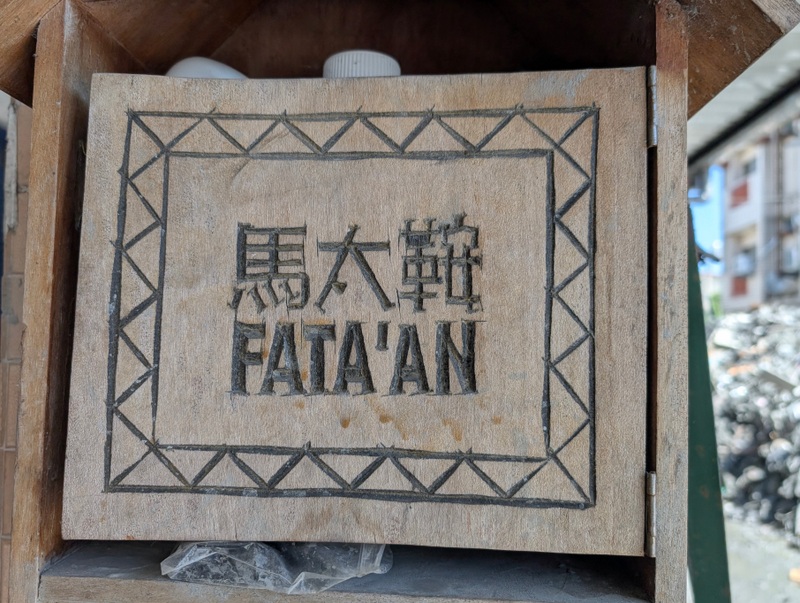
Half of the people in Guangfu belong to the Amis Tribe, and most of them are Christians, many Presbyterians. I met their pastor, also from the Amis Tribe, Rev. Chen, at his niece’s wedding in Advent Church in June; he told me he had been there in Guangfu for several decades. Fata’an Presbyterian Church in Guangfu is up on a hill, largely unaffected by the flooding, and is now open as a centre for relief distribution and as a rest area with medical help on offer. I went up there to have a look. The original name of the town was Fata’an (馬太鞍), a term for ‘pigeon peas’ in the Amis language, the most common crop grown in the area at the time. The name Fata’an, also written as Matai’an, is still the name of the river. In 1913, it became a key location for the Hualien Sugar Refinery, developed during the Japanese colonial era. The sugar refinery closed in 2002, and the site is now developed for tourism.
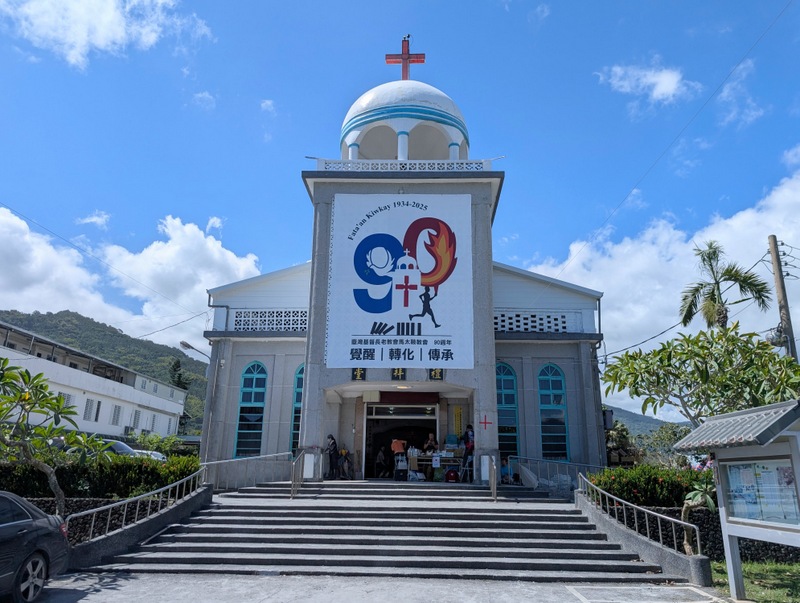



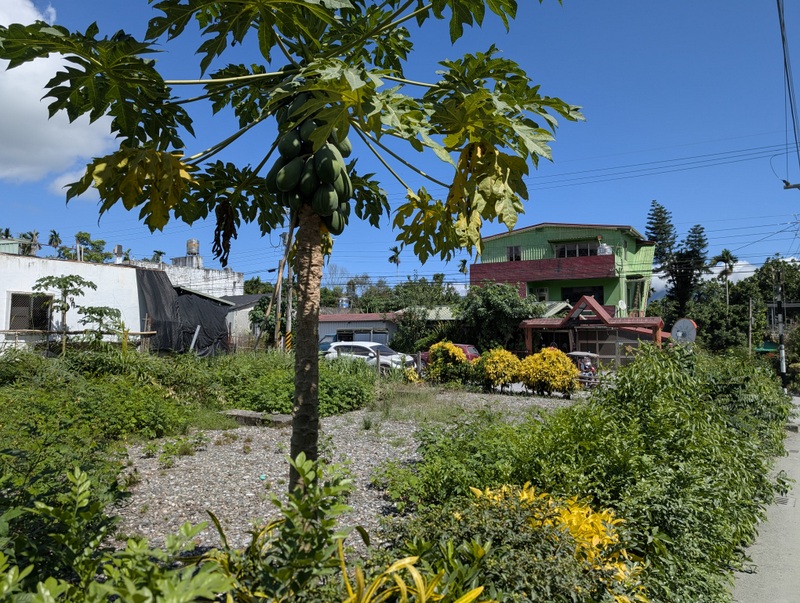
Guangfu is one of many small towns on the east coast railway line, and each one is keen to attract visitors to stop off and visit. Their railway stations are decorated with local symbols and tourist attractions, but when I went through there in May, I couldn’t see much at Guangfu Station. Apparently, the station is decorated with local Amis photos and art, but I remember I asked Rev. Chen at the wedding in June what Guangfu was famous for. Sadly, now I know.

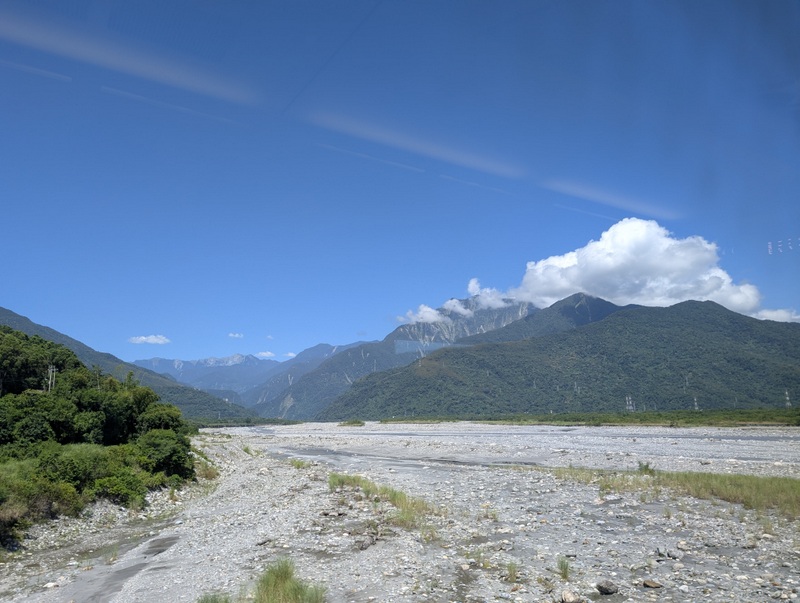
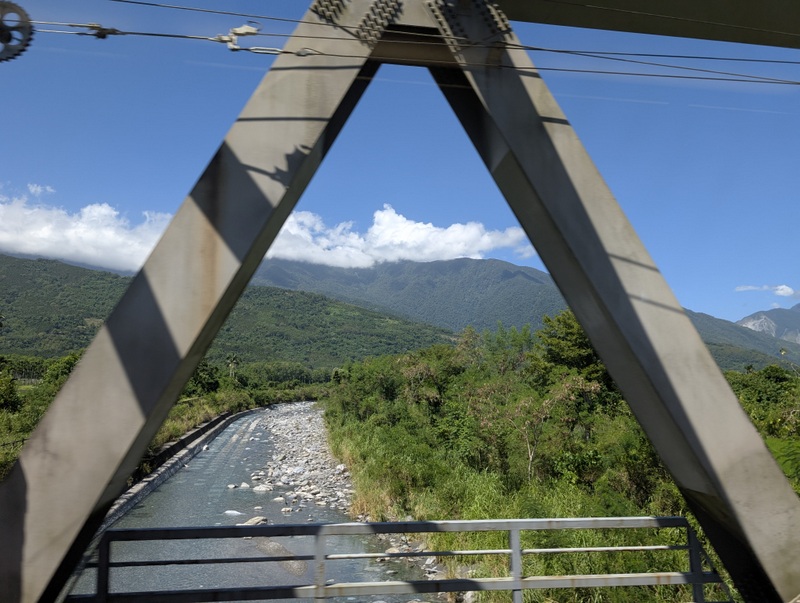
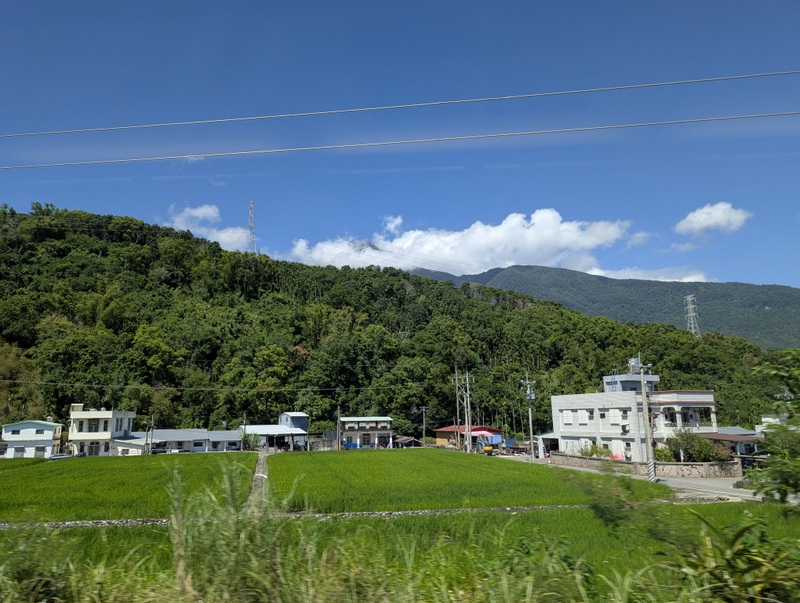
Estimates put the number of volunteers who turned up at Guangfu last weekend at 30,000-40,000 each day, most of them traveling there by train. Though the main road bridge over the Matai’an river was washed away in the flood, fortunately, the railway goes through a tunnel under that same river, and so has not been affected. People were encouraged to stay in Hualien and go by train each day, with many extra trains put on to accommodate everyone. The journey is about 30-40 minutes. That’s what we did. And the train journey from Hualien to Guangfu is beautiful, you’d never know that you were approaching a scene of a major disaster.




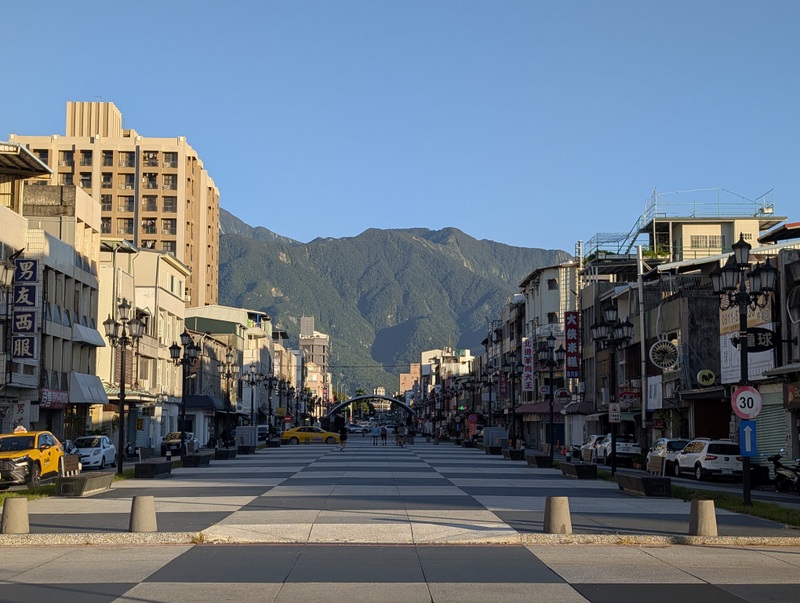
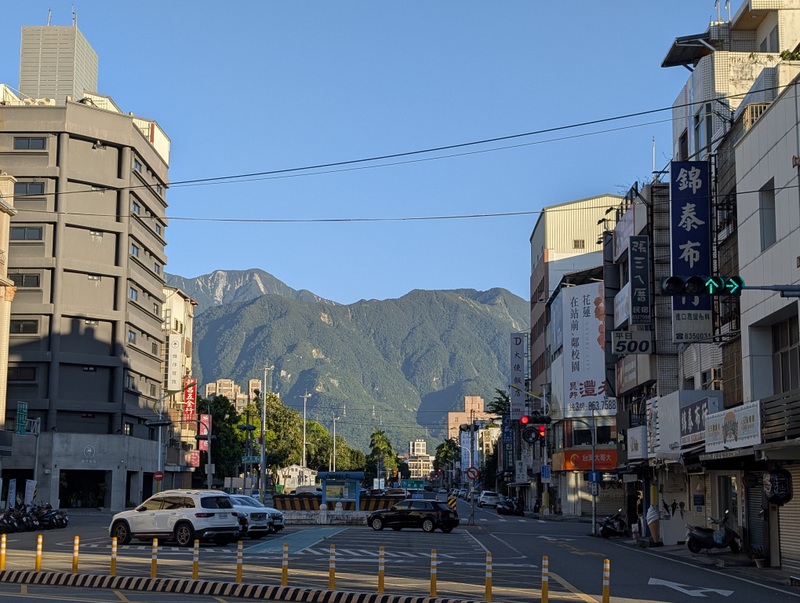
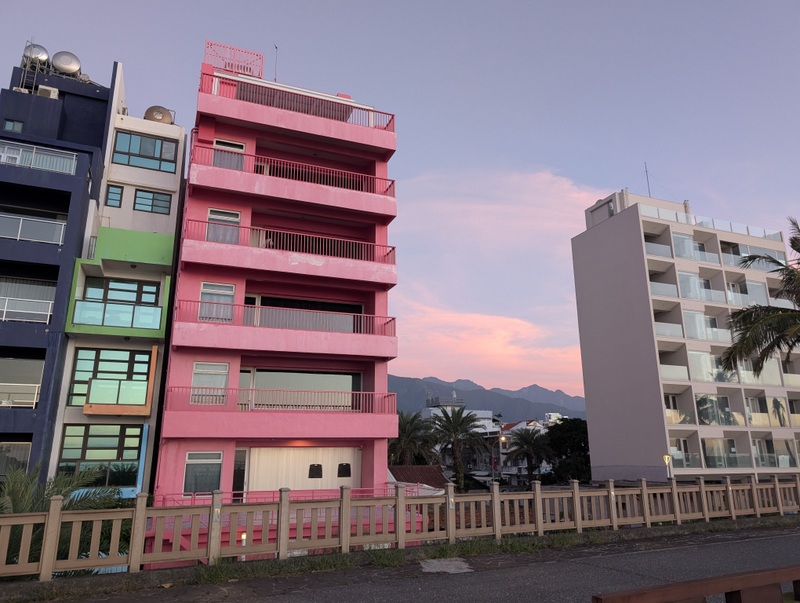
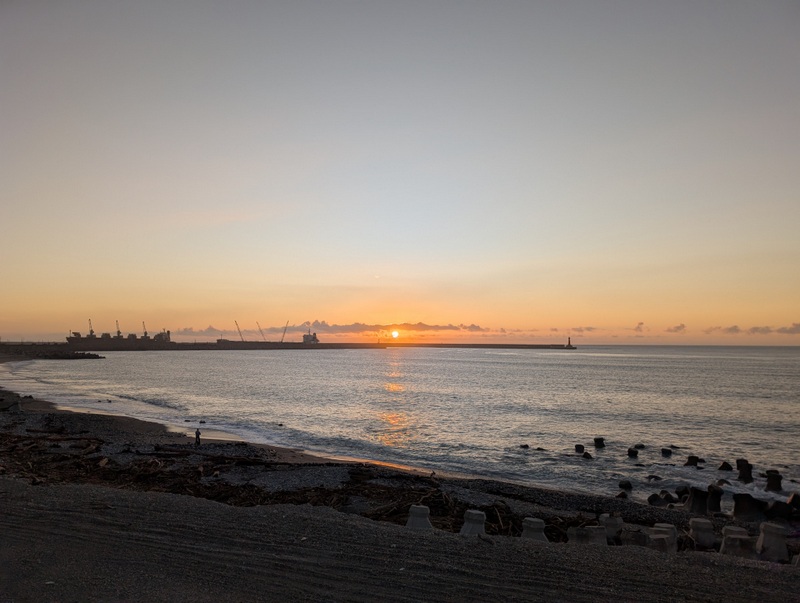
In Hualien, we stayed at a guest house run by one of St. Luke’s Church members. Its location reminds us that Hualien is a city on the edge. Everywhere you walk in the city are views of the high mountains. But our guest house view was of car parks. Whenever I see a car park in a place like Hualien, I always wonder what was there before. Local people said that one of the car parks had been the site of a hotel that collapsed in an earthquake some years ago. Another nearby building is a boarded-up hotel, awaiting demolition; it was damaged in last year’s earthquake, April 3, 2024, one that we felt, even in Taipei. But it’s not all doom and gloom. Sunrise over the Pacific Ocean was beautiful.


Please do pray for Dr. Kuo, his wife and family, his neighbours and the people of Guangfu, and all those in St. Luke’s Church, Hualien. Every year, Taiwan suffers from earthquakes and typhoons, and many of these are centred on Taiwan’s beautiful east coast. Just north of Hualien lies Taroko Gorge, Taiwan’s No. 1 tourist attraction; it is still recovering from last year’s earthquake and is only partially open. Once the disaster is over, and the news reports move elsewhere, relief and rebuilding will continue, while the economy always takes a very long time to recover. Tourists are put off from visiting, and yet, that is what they need to keep the economy going. Guangfu, once a small, relatively unknown town on Taiwan’s east coast, now thrust into the limelight, needs our help and prayers. Inundated with mud, now overflowing with compassion; when we asked Dr. Kuo’s neighbours about the future, they sighed and said, ‘We don’t know, we’re just taking it one day at a time’.

It was this verse from 1 Cor. 12:26: “If one member suffers, all suffer together; if one member is honored, all rejoice together,” that inspired our group from the Taiwan Episcopal Church to go to Guangfu to volunteer. Of the six of us who traveled there from Taipei on the Saturday night, all of the others were in their early twenties, mostly students, including Rev. Joseph Wu’s 2 children, Paul Yong-En, our team leader, and Teresa Yong-Ai. We also had Paloma and Timothy, and Timothy’s classmate. Then we had Rev. Joseph Ho and his family, who came on Sunday evening; they fondly recall the care and love they were shown by Dr. and Mrs. Kuo while Joseph was assigned as vicar of St. Luke’s Church a few years ago. Just in August, they had taken their children to Dr. Kuo’s dental clinic for examination. This time, Joseph came with us to help at Guangfu, while his wife, Angel and the children went to help with sorting relief goods to be sent to Guangfu. We also heard that Amy Chin, our Diocesan Chancellor and her husband, Gary Tseng were in Hualien helping to deliver goods to the frontline. We are grateful to Amy for instigating this project for us all to go to Hualien. We also had a team from St. Stephen’s Church, Keelung, Huang Min and Sunny who drove down for the day from Keelung, and a large devoted team from St. Luke’s Church, Hualien, plus Rev. Vivian Kuo, who came every day. Vicky, from our diocesan office came for a few days, overlapping with the visit of Bishop Lennon Chang and his wife, Hannah who visited the clinic on Wednesday, along with Mr. Yang from St. Luke’s Church, to encourage and pray with Dr. Kuo and wife, who had just returned from Macau (see the photo below). Everyone played a part, big or small, whether in digging out the mud, cleaning, sorting and delivering goods, in funding our train tickets and stay in Hualien, or in prayer and encouragement. Thanks to everyone who helped in any way, it was a great team effort and much appreciated. This weekend is another long weekend in Taiwan, this time for the Mid-Autumn Moon Festival, a time of family reunions and barbecues. Many volunteers have also gone to Guangfu, though in Dunhou Road, most of the debris has been cleared, and heavy work now involves cleaning the drains and helping further afield.

‘When one suffers, we all suffer together.’ That’s what loving our neighbour is all about. May we always be ready to love, help and serve those in need. ❤️
PS: Many of the young people featured above also attended mission trips to Los Angeles or Malaysia over the summer; they shared their testimonies and stories in the latest Diocesan Friendship Magazine, just published a few days ago: please check it out here – it’s 48 pages, a bumper issue!
 Catherine Lee
One thought on “花蓮光復洪災 Guangfu, Hualien, Taiwan: Inundated with Mud, Overflowing with Compassion ❤️”